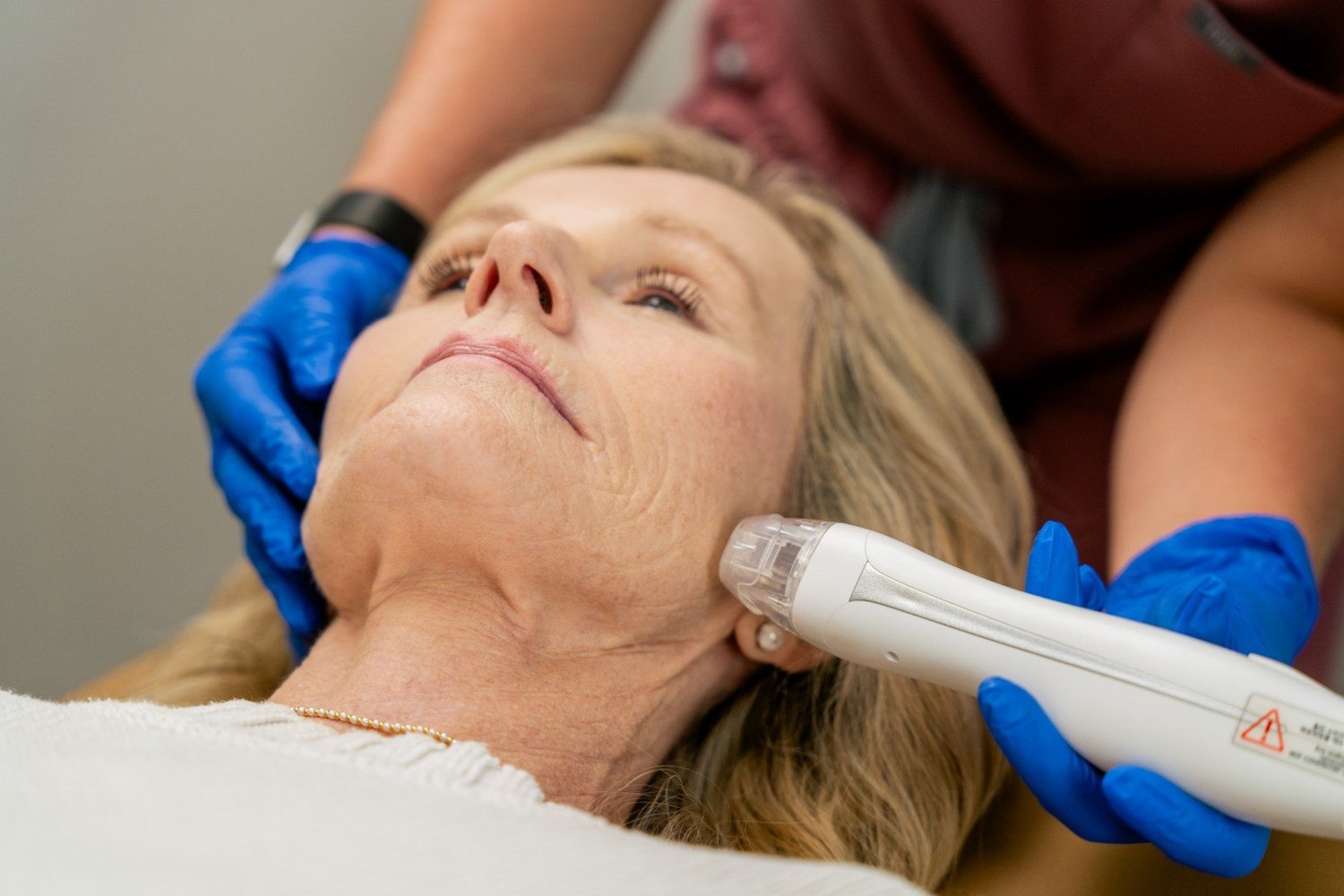
Halo® is a "hybrid" fractional laser that fires ablative and non-ablative wavelengths in the same pass; CoolPeel® is pure fractional CO₂ delivered in ultra-short pulses. Both are premium resurfacing treatments for texture, pores, fine lines, and sun damage. Here's how they actually compare for someone deciding in west Georgia.
The trade-offs in plain terms
Halo's hybrid approach delivers deeper coagulation alongside surface ablation — often marketed as one-and-done or two-session treatment, with roughly 5–7 days of swelling, redness, and the sandpapery "Halo glow" progression. CoolPeel spreads the work across a gentler series of 2–3 sessions with 1–3 days of recovery each. Total improvement lands in similar territory; the difference is whether you'd rather take your downtime in one big bite or several small ones.
| Halo® | CoolPeel® | |
|---|---|---|
| Approach | Hybrid ablative + non-ablative | Short-pulse fractional CO₂ |
| Downtime per session | ~5–7 days | 1–3 days |
| Sessions | 1–2 | 2–3 |
| Typical metro pricing | Often $1,500–$2,500+/session | See current pricing — series-friendly |
Which should you choose?
If your calendar can absorb a week of visible recovery and you want maximum single-session change, Halo's model has appeal — we'll tell you so honestly. For most of our patients, CoolPeel's schedule-friendly series wins the year: comparable cumulative results, recovery that fits between school pickups, and pricing that doesn't require an event to justify. Every laser plan here operates under the medical direction of a board-certified dermatologist, so the recommendation you get is clinical, not inventory-driven.
Start with the full CoolPeel guide or a free consultation with Visia imaging at any of our three studios.
Halo® is a registered trademark of Sciton, Inc.; Carroll Cosmetic Club is not affiliated with Sciton and does not offer Halo. Comparison reflects publicly available information as of September 2026.